
Last Updated: June 2026 | Reading Time: 10 minutes | Wellness-Reviewed for Accuracy
Introduction
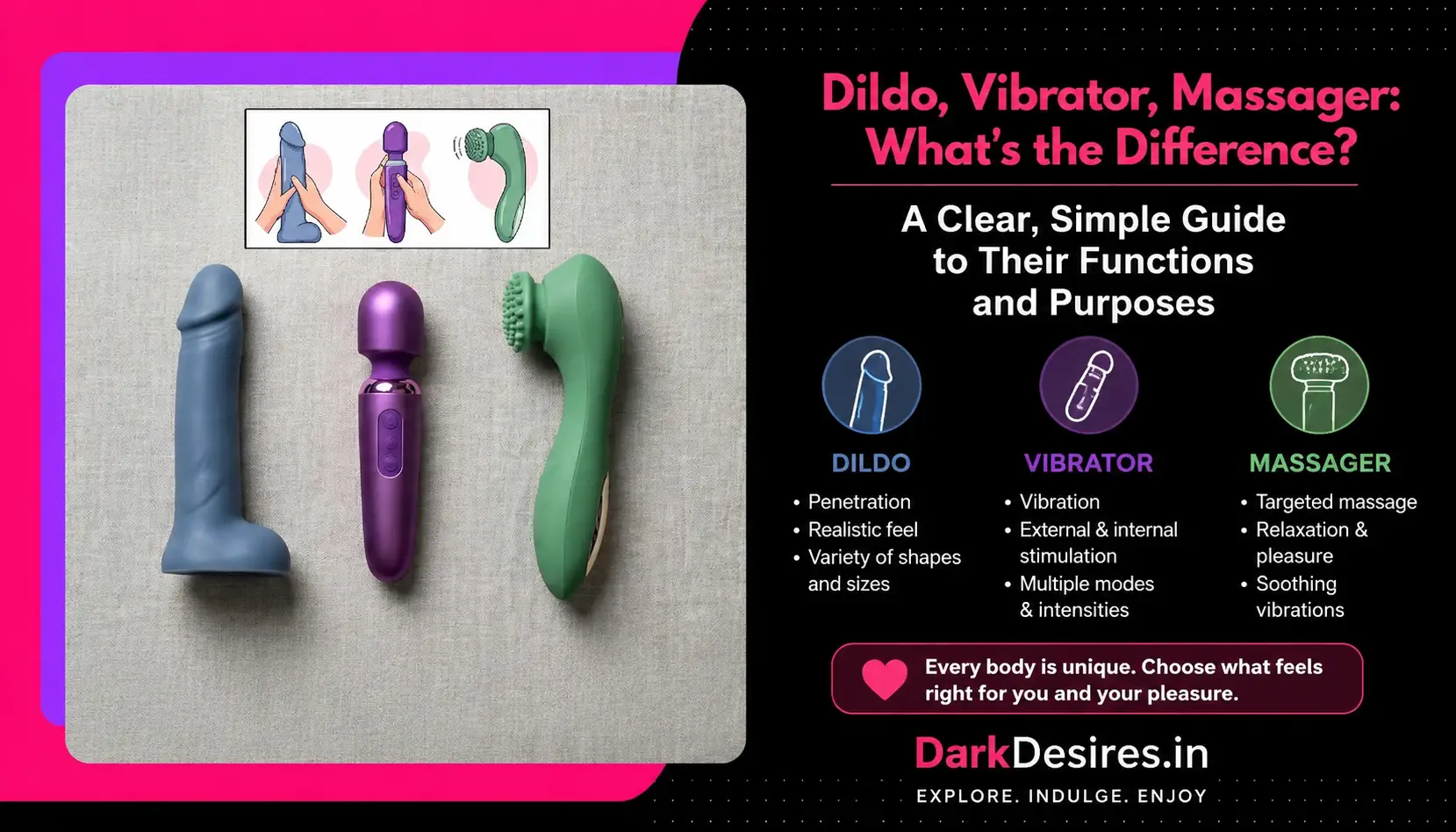
Walk into any conversation about intimate wellness products and three words come up constantly: dildo, vibrator, and massager. Most people use them interchangeably. Almost everyone is wrong to do so.
These are three genuinely different categories of product — different designs, different purposes, and different ways they interact with your body. If you have ever browsed an online store and felt confused about which product is actually which, you are far from alone. This confusion is made worse in India, where marketing language often deliberately blurs these lines.
This guide breaks down each category clearly, explains exactly how they work, and — importantly — exposes a common labelling practice in the Indian market that leaves many first-time buyers genuinely misled.
What Is a Dildo — And Only a Dildo?
A dildo is a toy designed specifically for penetration. That is the complete definition. No motor, no batteries, no vibration. It is simply an insertable object, shaped and crafted from body-safe material, used for vaginal or anal stimulation.
Dildos come in a wide variety of shapes and designs: realistic versions modelled after natural anatomy, abstract non-realistic shapes, curved designs for G-spot stimulation, double-ended versions for shared use between partners, and suction-cup base versions designed for hands-free use. Materials range from medical-grade silicone to borosilicate glass and stainless steel.
Who is a dildo for?
Anyone who specifically wants the sensation of fullness and penetration — without necessarily needing vibration. Dildos are used by women for vaginal stimulation, by men and women for anal stimulation, and by couples as part of shared intimate play.
What a dildo is not
A dildo does not vibrate. If a toy includes vibration, it is technically a vibrator — even if it is also insertable. A toy that combines both penetration and vibration has its own specific name: a vibrating dildo. This distinction genuinely matters when choosing the right product for your needs.
A practical note for Indian buyers: Most dildos sold in India are imported from international markets where sizing is calibrated for different average anatomy. If this is your first dildo purchase, always start smaller than you think you need. Sizing up later is simple — a uncomfortable or painful first experience is much harder to recover from emotionally.
What Is a Vibrator — Explained Properly?
A vibrator is any toy that produces vibration through an internal motor. The oscillating sensation stimulates nerve endings in a way manual touch alone cannot replicate — which is precisely why vibrators are widely regarded as the most reliably effective tool for female orgasm.
Here is something that surprises many first-time buyers: most vibrators are not designed for internal insertion at all. Bullet vibrators, wand vibrators, and clitoral vibrators are all designed for external use — placed against the body, specifically the clitoris. The clitoris contains over 8,000 nerve endings, more concentrated sensitivity than anywhere else in the human body, and vibration reaches those nerve endings with remarkable efficiency.
Main Types of Vibrators
| Type | How It’s Used | Best For |
|---|---|---|
| Bullet vibrator | External, held against the clitoris | Clitoral orgasm, discreet size, beginners |
| Wand vibrator | External, broad head against body | Powerful stimulation, doubles as massage tool |
| Rabbit vibrator | Internal and external simultaneously | Blended G-spot and clitoral orgasm |
| G-spot vibrator | Internal, curved design | Internal stimulation with added vibration |
| Vibrating dildo | Internal, combines penetration and vibration | Full penetration with added sensation |
| Vibrating cock ring | Worn on the penis during intercourse | Couples — vibration benefits both partners |
| Prostate vibrator | Internal, designed for men | Prostate (P-spot) and perineum stimulation |
Why Most Women Need a Vibrator, Not Just a Dildo
Research consistently shows that the majority of women do not reach orgasm through vaginal penetration alone. The clitoris — not the vaginal canal — is the primary organ responsible for female sexual pleasure. Vibrators stimulate this area directly and effectively, which is why a clitoral vibrator is frequently described by sexual health professionals as the single most reliably useful intimate product a woman can own.
What Is a Massager — And Why Does It Cause So Much Confusion in India?
A genuine massager, in the traditional sense, is a device built to relieve muscle tension and soreness. It is used externally on the neck, shoulders, back, thighs, and arms. A back massager is a physiotherapy and wellness tool — it has existed for decades and has nothing inherently to do with intimate wellness.
Here is where things get genuinely confusing for Indian buyers: a number of Indian intimate wellness brands have started labelling their vibrators as “massagers” or “personal massagers” rather than describing them accurately.
Why does this happen?
The word “massager” carries far less social friction. It is less likely to be flagged or rejected by advertising platforms like Meta and Google Ads. It sounds clinical and wellness-oriented rather than explicitly intimate. It allows brands to market and discuss their products without language that might make buyers uncomfortable, especially in a market where stigma remains high.
This is understandable from a marketing standpoint — but it leaves genuine confusion for buyers trying to understand exactly what they are purchasing.
The simple truth: when an Indian brand markets a “personal massager” or “intimate wellness wand,” it is, in the overwhelming majority of cases, a vibrator — designed for clitoral or genital stimulation, not the tension in your shoulders after a long day.
How to Tell a True Massager From a Vibrator Marketed as One
| Feature | True Body Massager | Vibrator Labelled as a “Massager” |
|---|---|---|
| Shape | Broad, ergonomic, designed for large muscle areas | Curved, bullet-shaped, or fitted with a clitoral arm |
| Contact area | Large surface, palm-sized coverage | Small and precisely targeted |
| Vibration type | Deep percussion for muscle tissue | Pinpoint surface vibration for nerve endings |
| Material | Plastic, foam, rubber — rarely body-safe silicone | Medical-grade silicone, if a quality product |
| Waterproofing | Usually not waterproof | Usually IPX5–IPX7 waterproof rated |
| Where it’s sold | Pharmacies, physiotherapy suppliers, general retail | Dedicated intimate wellness stores |
| Product description language | “Massage,” “muscle relief,” “physiotherapy” | “Personal wellness,” “intimate care,” “for her” |
There is one genuine exception worth noting: a high-quality wand vibrator with a large rounded head and strong motor can legitimately double as a back and shoulder massage tool — this is actually part of why wand vibrators became so popular in the first place. But even then, body massage is a secondary use of what is fundamentally an intimate product, not the reverse.
Quick Reference Summary
| Product | What It Does | Has a Motor? | Insertable? | Designed For |
|---|---|---|---|---|
| Dildo | Penetration, physical fullness | No | Yes | Women, men (anal use), couples |
| Vibrator | Vibration, stimulates nerve endings | Yes | Some types | Everyone |
| True Massager | Relieves muscle tension | Yes (percussion) | Never | Anyone with sore muscles |
| “Personal Massager” | Actually a vibrator for intimate use | Yes | Some types | Primarily women |
Benefits of Understanding the Difference
1. You Buy the Right Product the First Time
Understanding these distinctions prevents the common and frustrating mistake of buying a product that does not match your actual needs — for example, purchasing a non-vibrating dildo when what you actually wanted was clitoral stimulation, or vice versa.
2. You Avoid Being Misled by Marketing Language
Once you understand why some Indian brands relabel vibrators as “massagers,” you can read product listings more accurately and make a genuinely informed purchase decision rather than being confused by euphemistic language.
3. You Can Match the Product to Your Specific Pleasure Needs
Since most women require clitoral stimulation to reach orgasm, understanding that distinction can be genuinely transformative — many women who have only tried penetration-only products discover significantly more satisfying experiences once they understand and try vibration-based external stimulation.
4. You Make Safer, More Confident Purchases
Knowing what questions to ask — is this insertable, does it vibrate, what is it made from — gives you confidence when browsing, rather than guessing based on product photos alone.
5. You Can Better Communicate With a Partner
Having accurate language for these products makes conversations with a partner about preferences, desires, and shared exploration significantly clearer and more comfortable.
How to Choose the Right Product Safely
Step 1: Identify What Kind of Stimulation You’re Actually Looking For
Ask yourself directly: do you want the sensation of fullness and penetration (a dildo), targeted vibration and nerve stimulation (a vibrator), or genuine muscle relief (a true massager)? Being honest about this from the start prevents a mismatched purchase.
Step 2: Read Past the Marketing Language
If a product is labelled a “massager” but is being sold on an intimate wellness platform, marketed with words like “intimate,” “for her,” or “wellness wand,” and is shaped with a curved or precise tip — it is very likely a vibrator. Check the shape, the platform it is sold on, and the specific language used in the full description, not just the product name.
Step 3: Always Prioritise Body-Safe Materials
Regardless of category, the gold standard for any toy that contacts the body — especially for internal use — is medical-grade silicone, which is non-porous, phthalate-free, BPA-free, and easy to clean thoroughly. Borosilicate glass and surgical-grade stainless steel are also excellent, safe options. Avoid toys made from unlabelled “skin-safe” materials or jelly rubber, which are often porous and may contain harmful chemicals.
Step 4: Check Whether the Product Is Designed for Internal Use
Not every toy is safe for insertion. External vibrators — bullets, clitoral vibrators, wands — are designed for outside-the-body use only. Only insert a product that is explicitly described as safe for internal use, and for anal use specifically, ensure it has a flared base or a retrieval cord.
Step 5: Start With a Beginner-Friendly Size and Intensity
Whether choosing a dildo or a vibrator, beginners should start with smaller sizes and lower vibration intensities, increasing gradually as comfort and familiarity grow.
Step 6: Always Use Water-Based Lubricant
Regardless of product type, water-based lubricant enhances comfort, reduces friction, and protects the surface of silicone products. Avoid oil-based or silicone-based lubricants with silicone toys.
Step 7: Clean and Store Properly
Clean all products with warm water and mild, unscented soap before first use and after every subsequent use. Dry thoroughly before storing in a clean, discreet, dry location, away from direct sunlight.
Common Mistakes Buyers Make
Assuming All Three Terms Mean the Same Thing
This is the single most common mistake, and the entire reason this confusion exists in the first place. A dildo, a vibrator, and a massager are fundamentally different products with different functions — treating them as interchangeable leads to disappointing purchases.
Buying a Non-Vibrating Dildo When Clitoral Stimulation Was the Actual Goal
Since most women require clitoral stimulation to orgasm, buying a non-vibrating dildo as a first product — without understanding this — often leads to an unsatisfying experience that has nothing to do with the product’s quality and everything to do with a mismatch in expectations.
Taking “Massager” Labelling at Face Value
Assuming a product labelled “personal massager” by an Indian brand is genuinely a muscle-relief device, when it is very likely a vibrator marketed with softer language. Always check the shape, sales platform, and detailed description.
Ignoring Material Information
Choosing a product based on appearance or price alone, without checking whether it is made from medical-grade silicone or another genuinely body-safe material, increases the risk of skin irritation and infection.
Inserting External-Only Vibrators
Attempting to insert a bullet or wand vibrator that was not designed for internal use can be uncomfortable or unsafe. Always confirm a product is explicitly designed for internal use before inserting it.
Starting With Too Much Intensity
Jumping to the highest vibration setting or the largest size on a first attempt often leads to a negative first experience. Start low and slow, regardless of product category.
Frequently Asked Questions (FAQs)
Q1. What is the difference between a dildo and a vibrator? A dildo has no motor and is designed purely for penetration. A vibrator has a motor and is designed to stimulate nerve endings through vibration. The simplest way to remember it: dildos penetrate, vibrators vibrate. Some toys do both — these are specifically called vibrating dildos.
Q2. Is a massager the same as a vibrator? No. A true massager is a physiotherapy device designed for external muscle relief. In India, however, many intimate wellness brands use the word “massager” to describe what are actually vibrators, in order to make their products more socially acceptable and easier to market and advertise. When you see “personal massager” from an Indian intimate brand, it is almost always a vibrator.
Q3. Which is better for a woman — a dildo or a vibrator? It depends entirely on what kind of stimulation she prefers. If she enjoys the sensation of fullness and penetration, a dildo is the right choice. If she primarily reaches orgasm through clitoral stimulation — which is the case for most women — a vibrator will be more reliably effective. For first-time buyers, a clitoral or bullet vibrator is the most commonly recommended starting point.
Q4. Can a dildo vibrate? Yes. A vibrating dildo is insertable like a standard dildo but also includes a built-in motor, giving you both penetration and vibration simultaneously. Always check the product listing to confirm whether a specific toy vibrates or not before purchasing.
Q5. Why do Indian brands call vibrators “massagers”? This is primarily a marketing decision. The word “massager” is less likely to be flagged or restricted by advertising platforms like Meta and Google Ads, and it feels more clinically acceptable to buyers who might otherwise feel uncomfortable purchasing something explicitly labelled as an intimate product.
Q6. Is it safe to insert a vibrator? Only if it is specifically designed for internal use. External vibrators — bullets, clitoral vibrators, and wands — are intended for outside-the-body use only. Only insert a toy that is explicitly described as safe for internal use, made from body-safe materials, and — for anal use — has a flared base or retrieval cord.
Q7. Can men use vibrators? Absolutely. Men use vibrators for penile and perineum stimulation, as well as for prostate stimulation. Vibrating cock rings are among the most popular options for couples, and prostate vibrators are one of the fastest-growing categories in men’s intimate wellness in India.
Q8. What is the best first intimate product for a woman in India? For most first-time buyers, a small clitoral or bullet vibrator is the recommended starting point — it is discreet, affordable, easy to use, and delivers the type of stimulation most women respond to most strongly. If penetration is specifically desired, a small, beginner-friendly dildo is the right choice. For both sensations simultaneously, a rabbit vibrator provides internal and clitoral stimulation at the same time.
Q9. Do intimate products need to be made of silicone? For any product that contacts the body — especially for internal use — medical-grade silicone is the gold standard. It is non-porous, phthalate-free, BPA-free, and easy to clean thoroughly. Borosilicate glass and surgical-grade stainless steel are also safe alternatives. Avoid products made from jelly rubber or vaguely labelled “skin-safe” materials, as these are often porous and may contain harmful chemicals.
Expert Advice
Sexual wellness educators and product safety specialists offer the following guidance on choosing between these product categories:
Clitoral anatomy should guide most first purchases for women. Given that the clitoris is the primary site of orgasmic response for most women, sexual health professionals frequently recommend that first-time buyers consider an external vibrator before — or alongside — any penetrative product, regardless of marketing trends that emphasise penetrative toys.
Material safety standards do not change based on product category. Whether you are buying a dildo, a vibrator, or any other intimate product, medical-grade silicone, body-safe ABS plastic, borosilicate glass, or surgical-grade stainless steel remain the only categories of material recommended for direct, repeated body contact.
Euphemistic labelling is a market reality, not a red flag in itself. The relabelling of vibrators as “massagers” in India reflects regulatory and cultural pressures on marketing language, not necessarily a sign of an untrustworthy brand. The key is for buyers to read past the label and assess the actual product description, materials, and intended use.
Combining product types often produces the most satisfying outcomes. Many sexual health professionals note that couples and individuals who understand and use a combination — for example, a dildo for penetration alongside a vibrator for clitoral stimulation — often report higher satisfaction than relying on a single product type alone.
Conclusion
A dildo, a vibrator, and a massager are three genuinely different products, each serving a distinct purpose. Understanding these differences — and recognising how Indian marketing language sometimes blurs the lines between them — empowers you to make confident, informed, and genuinely satisfying purchase decisions.
The key things to remember:
- A dildo has no motor and is designed purely for penetration
- A vibrator has a motor and stimulates nerve endings through vibration — most are designed for external clitoral use
- A true massager is a physiotherapy tool for muscle relief, unrelated to intimate stimulation
- Many Indian brands label vibrators as “personal massagers” for marketing reasons — read past the label
- Always prioritise medical-grade silicone or other genuinely body-safe materials, regardless of category
- Most women require clitoral stimulation to reach orgasm — a vibrator is often the most effective starting product
- Combining a dildo and a vibrator often produces the most satisfying overall experience
Understanding exactly what you are buying — and why — is the first step toward a genuinely satisfying intimate wellness purchase.
Disclaimer: This article is for educational and informational purposes only. It does not constitute medical advice. Always consult a qualified healthcare professional for personal health concerns related to sexual wellness.